Have you thought about the way you breathe?
We ask this question all the time in clinic, and not just to someone who came in for pelvic floor issues.
Even people who AREN'T dealing with the more obvious pain or leaking when they sneeze or run are often inefficiently breathing or bracing.
Some examples of patients I’ve seen this week include:
A runner with knee pain who holds their breath during hills,
A desk worker with neck tension who chest breathe all day, and
A lifter who brace so hard during squats that they're creating massive intra-abdominal pressure without proper coordination.
Most people have never thought about their breathing pattern, and it shows.
When your breathing mechanics are off, your pelvic floor often takes the hit. Its position at the bottom of the pressure system makes it the perfect place for compensations to accumulate. People dealing with leaking, pressure, heaviness, or pelvic pain are just the people experiencing the most obvious consequences of a system that's not coordinating well.
But these aren’t the only symptoms.
As mentioned above, people with pelvic floor or breathing dysfunction might also have:
Lower back pain,
Neck pain,
“Pinched” nerves,
Hernias (of all kinds),
Shoulder pain,
Rotator cuff dysfunction,
SIJ dysfunction,
Hip pain,
Sciatica,
…pretty much everything?
Your core isn't just really a muscle group, it's a canister. The diaphragm forms the top, the pelvic floor forms the bottom, your deep abdominal muscles wrap around the front, sides, and back.
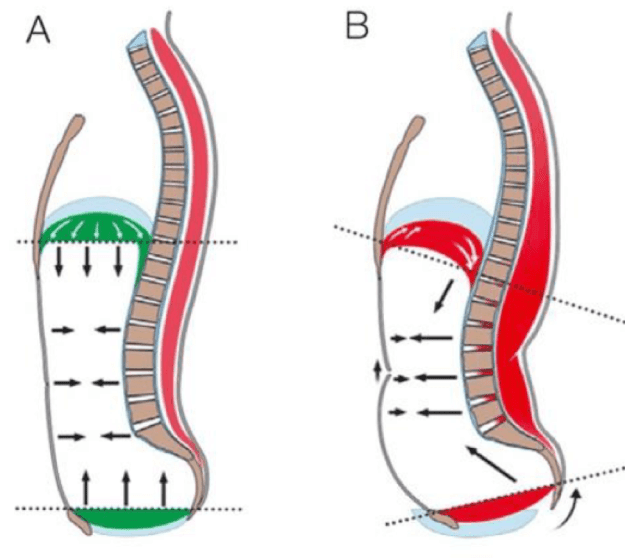
These structures work together to manage intra-abdominal pressure during literally everything you do. Breathing, moving, lifting, laughing, coughing, running, etc., all of it requires this system to coordinate effectively.
When you breathe in, your diaphragm contracts and moves downward. As it descends, it increases pressure in your abdominal cavity.
Your pelvic floor should respond dynamically by supporting and managing these increased forces as a coordinated dance happening thousands of times a day without you thinking about it.
Except when it doesn't work that way.
What we see in clinic are breathing patterns that have lost this coordination. Someone who breathes up into their chest instead of allowing their diaphragm to move fully. Someone who holds their breath during any kind of effort (lifting weights, carrying groceries, picking up their kid). Someone whose pelvic floor has learned to stay contracted all the time, never fully relaxing.
When the body doesn’t have the most efficient option available, it chooses the next best one. The only problem is that backup plan is unlikely to be sustainable for the long term demands of life.
Rather than having subconsciously dysfunctional bracing and breathing patterns, you may have been taught them.
Plenty of physios, personal trainers, or other fitness instructors are taught to teach you to suck in or brace down. At best maybe they’ve never acknowledged your breathing or bracing. Maybe you've just never been taught that breathing is a skill that can be trained and optimized.
Whatever the reason, when your breathing pattern and pelvic floor coordination are off, your body has to compensate.
Contrary to what most think, pelvic symptoms or urinary incontinence aren’t usually the result of simple weakness. Which also means that kegels can’t fix everything. These symptoms are frequently about muscles that never relax, that are holding tension constantly, that can't lengthen and release the way they're supposed to.
You can do kegels constantly, but if your pelvic floor doesn't know how to relax, and it’s not working in timing with the rest of the system, you're just adding more tension to an already overactive system.
Everyone benefits from better breathing mechanics and pressure management.
But if you're dealing with pelvic floor symptoms (leaking when you sneeze, laugh, run, or lift; pressure, heaviness, or pain in your pelvic area; symptoms that persist despite doing core exercises and kegels) then understanding this system isn't just beneficial, it's essential.

COME JOIN US
APRIL 25TH 11AM-3PM
This is exactly what Jessica Hetherington and Maxine Latinus will be addressing in their upcoming workshop, with a specific focus on pelvic floor concerns.
They're diving deep into why leaking, pressure, and pelvic pain happen, and what your core, breath, and nervous system have to do with it.
Consistent with what ROOTS is always dedicated to bringing you, this isn't another workshop teaching you kegels or basic core exercises, it's about understanding the actual system you're working with.
Because understanding the system changes everything. It shifts you from endlessly doing exercises that don't work to actually addressing why your body is responding the way it is. It gives you the tools to assess your own breathing patterns, your pressure management strategies, and how your nervous system is influencing your symptoms.
Your pelvic floor is at the literal center of your body, influencing everything you do. It deserves more than isolated kegels and hope. It deserves an approach that respects how connected and complex this system actually is.