What happens when physiotherapy ends?
This is a question best answered by first understanding what your goal is. Like all industries there’s a spectrum of needs and of services. In physiotherapy more or less we’re functioning on a spectrum of instant gratification superficial pain relief to lasting fundamental resilience.
It’s not to say aiming for one is objectively correct, they’re just inherently different.
On the surface, most clients first come to physiotherapy because of an active pain or limitation from their desired function, rather than to prevent them from occurring.
In those first sessions one inevitable question is “what’s it going to take?” but well, that depends on what “it” is. Everyone’s ideal outcome isn’t the same.
For example, your goal might be a clinical end point such as “pain-free” where ours trend closer to a fundamental status shift (e.g. “movement mastery” and “nuanced body awareness”).
Naturally, as humans, we are driven equally towards what comes to us fast and what gives us a sense of control. We want finite answers, timelines, diagnoses, thresholds, and clearly defined results. But we also want them quickly and cheaply.
There’s just one problem…
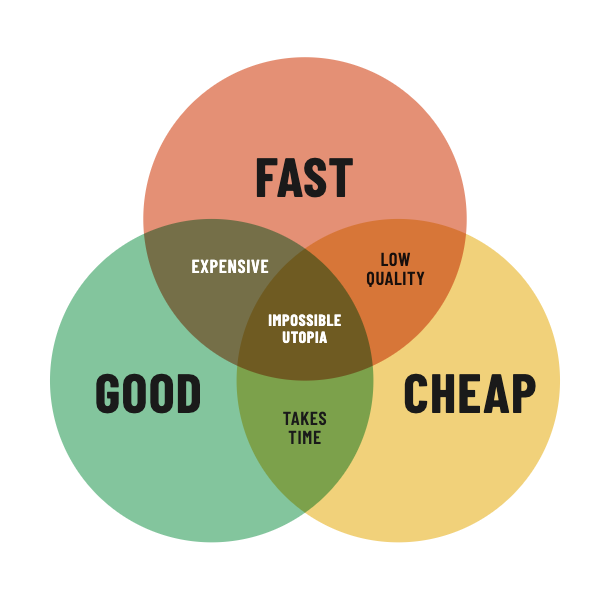
Believe me, I want that utopia to be realistic, too. However, I also have too much integrity to sell you that dream.
I remember a patient from a few years ago, who arrived 20 minutes late to his evaluation in a flurry of energy. He was in his late 60s, dressed in a button down and dress pants with a mismatched backpack rambling without a greeting about his chronic back pain.
Once I got my hands around the problem I started trying to unravel the expectation he came in with: I need to feel better before my trip next week.
He stopped me mid pitch on the deeper work that we clearly needed to do. A plan that would start today but extend well past the trip and only fully take shape as we got into it.
I naively thought he might have a question but instead he reached into his bag and pulled out a stack of cash large enough that it couldn’t have fit in his pocket making me wonder if this was why he was late and carrying that backpack in the first place.
“I’ll give you all of this right now if you can tell me exactly how many sessions it will take you to fix me 100%.”
If I was a man, or a dumber woman, I probably would have taken it. From across a street anyone could have concluded this man needed a revelation, both physically and mentally, that was well beyond my scope of practice.
I wish things worked like that. I wish we could give that to all of you. If not solely because I’d add at least one 0 to all of our prices if we could.
I don’t think that people are inherently stupid. I believe that when prompted most would agree that some of the best life comes to offer comes through consistency, time, and effort.
It’s just that we also want to believe in the dream of attaining hard-won results…without the hard part.
“Can’t I just come in and have you fix it for me?”
It does sounds nice, doesn’t it? The complete deferment of all responsibility. And if all you want is affordable, superficial, temporary pain-relief, you can find that. It’s going to be a low quality outcome, though.
I should probably collect some quantitative data on this but, anecdotally the average person is probably anticipating investing 1-3 months in their physiotherapy. With the idea that at the end of that, they walk away from it fully. That a problem is being “fixed” like bringing your car to the shop.
What if I told you that stopping at 1-3 months would leave you with results that lasted about the same amount of time?
But that if you went a little bit deeper, they might last for a few years?
And at the end of that, that if you went just a little bit further, those results might last for a decade or two?
Often I find that suddenly, within this new context, superficial pain relief doesn’t sound as appealing.
If we updated the schematic to match the work we’re talking about…
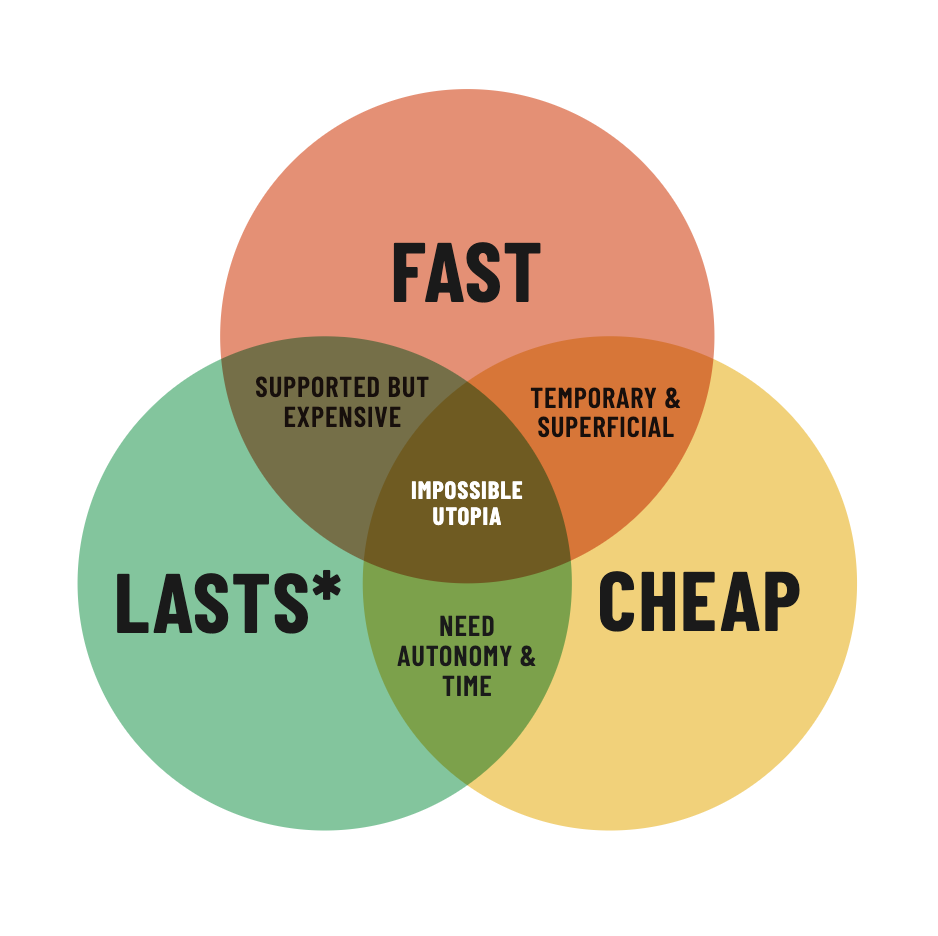
ROOTS exists in the green, dedicated to results that last. However you want to do them.
You might come in for some acute management but the end of formal physiotherapy should be the beginning of a long standing movement practice.
More or less the work never ends. You just don’t need us in the same role as we’ve passed you the reigns.
In the acute work, we serve as an external feedback system which we gradually transition to an internal one that you carry with you every day. Our revised role then realistically becomes that of a mentor rather than a teacher.
I’m sure you’re not surprised to find that that patient never came back, but many others have. The ones who really “get it” never left, we just don’t see them as much.
At ROOTS, rather than discharge you, we graduate you. To ROOTS Check-ups. These semi-annual movement screens are built for healthy, active systems so we can keep them that way.
This transition, done well, is actually where the real transformation happens.